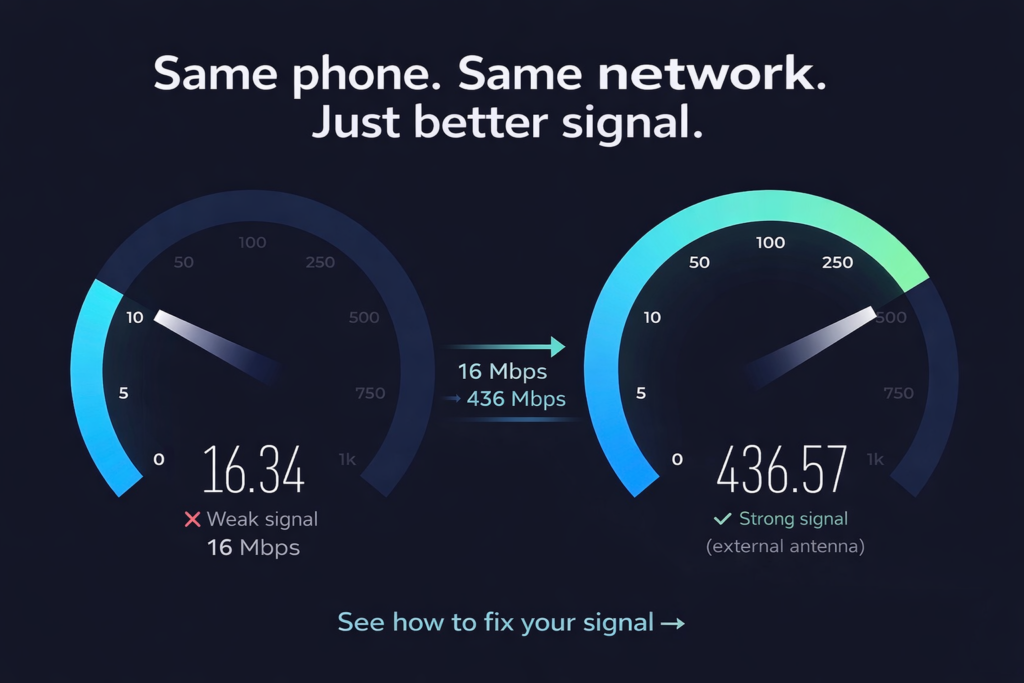
The real reason your internet is slow (it’s not your plan)
If your internet is slow, buffering, or dropping out — especially on 4G or 5G — the problem is almost never your data plan.
It’s signal strength and signal quality.
Most people assume:
- “I need a better provider”
- “I need Starlink”
- “I need a more expensive plan”
In reality, the issue is much simpler:
Your device isn’t receiving enough usable signal to deliver high speeds.
Why your phone shows “bars” but your internet is still slow
You’ve probably seen this:
- 2–3 bars of signal
- but painfully slow speeds
That’s because signal “bars” don’t tell the full story.
What actually matters:
- Signal strength (RSSI / RSRP)
- Signal quality (interference + noise)
- Network congestion
And here’s the key problem:
The antenna inside your phone or router is extremely weak
Typical internal antennas:
- ~0 to -2 dBi gain
- blocked by walls, roofs, and metal structures
So even if there’s usable signal outside your house…
👉 your device can’t properly receive it
Why rural and indoor users suffer the most
If you’re:
- in a rural area
- inside a metal shed or house
- behind trees, hills, or buildings
Your signal is being:
- absorbed
- reflected
- scattered
Which leads to:
- unstable speeds
- dropouts
- high latency
The mistake most people make
When faced with slow internet, people usually:
❌ Change providers
❌ Upgrade plans
❌ Buy WiFi boosters
❌ Switch to satellite (e.g. Starlink)
These rarely fix the root cause.
Why?
Because:
- WiFi boosters only improve internal distribution, not incoming signal
- Changing providers doesn’t fix physics
- Satellite adds latency and cost
The fix: capture a stronger signal (before it reaches your router)
Instead of trying to fix internet inside your house…
👉 You fix the signal BEFORE it gets there
This is done using a high-gain external antenna
Why external antennas work
A proper external antenna:
- Is mounted outside (clear line of sight)
- Has 10–15× the signal capture ability of a phone
- Focuses on the nearest cell tower
Result:
✔ Stronger signal
✔ Higher data rates
✔ More stable connection
✔ Lower latency
Real-world example
Typical scenario:
| Setup | Signal | Speed |
|---|---|---|
| Phone indoors | 1–2 bars | 2–10 Mbps |
| Router + external antenna | Strong | 50–150+ Mbps |
👉 Same network
👉 Same plan
👉 Completely different result
When this works best
This solution is ideal if you:
- Have any usable signal outdoors
- Get at least 1–2 bars on your phone outside
- Are using:
- Telstra / Optus / Vodafone (AU)
- Verizon / AT&T / T-Mobile (US)
When you might NOT need this
If you:
- Already have fibre or cable
- Have zero mobile signal anywhere
Then other solutions may be required.
External antenna vs Starlink (the reality)
Starlink is often marketed as the “only” rural solution.
But in many cases:
If you already have mobile coverage:
- External antenna = cheaper
- Lower latency
- No satellite dropouts
- Lower monthly cost
Satellite makes sense if:
- You are completely off-grid
- No mobile coverage exists
👉 Otherwise, it’s often overkill
The simplest upgrade you can make
Instead of replacing your provider…
👉 Upgrade your signal
A high-gain directional antenna can:
- turn unusable signal into usable internet
- unlock the full speed of 4G / 5G networks
- outperform satellite in many scenarios
Recommended setup (what actually works)
For best results:
Entry level:
- Single directional antenna
Performance:
- Dual (MIMO) antenna setup
Maximum performance:
- 4×4 MIMO antenna system
See the difference for yourself
If you’re currently dealing with:
- slow speeds
- unstable connection
- poor indoor signal
Then the solution is not more bandwidth…
👉 It’s better signal.
👉 View high-gain 4G / 5G antenna options
- Single LPDA antenna (entry level)
- V-Stack LPDA (higher gain)
- 2×2 and 4×4 MIMO systems
[Find the right antenna for your setup → https://www.hd-quad.com/product-category/fwa-antenna/]
Final takeaway
You don’t need a new provider.
You need a better way to receive the signal you already have.
Fix that — and everything changes.