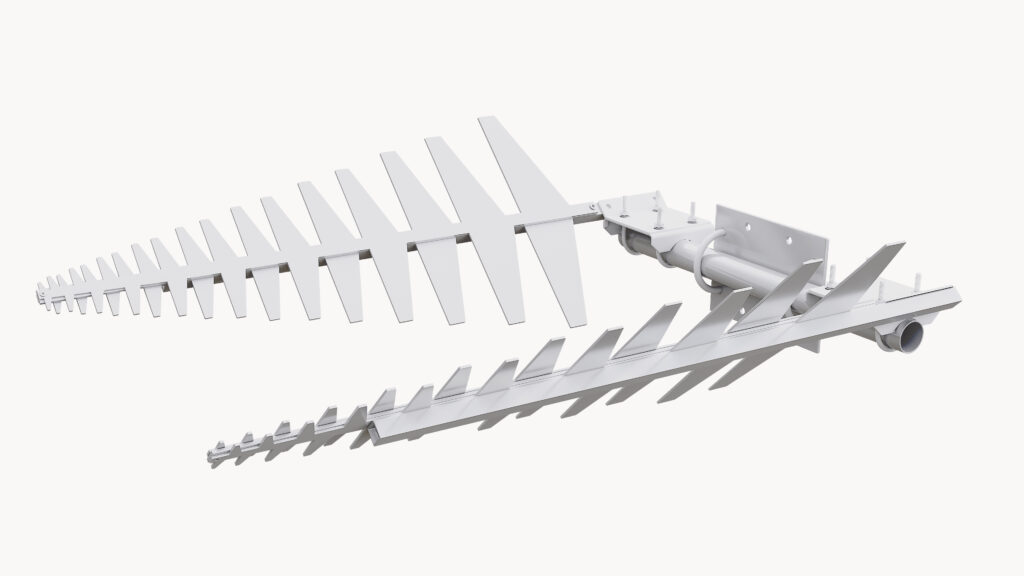
If you are using 5G Fixed Wireless Access (FWA) in a rural or suburban area, you have likely heard of MIMO (Multiple Input, Multiple Output). But there is a silent speed-killer that most DIY installers overlook: Polarization Mismatch.
At HD-QUAD, we engineered the Air Fiber Dual & Quad with a fixed ±45° Slant Mounting Kit for one specific reason: it is the only way to unlock the full mathematical potential of a 5G data stream.
1. The Physics of “Invisible” Signal Alignment
Radio waves don’t just travel as points of data; they have a physical orientation (Polarization). Imagine trying to slide a flat piece of mail through a vertical slot. If the mail is horizontal, it won’t fit.
In cellular networking, if the tower is transmitting a “Vertical” signal and your antenna is “Horizontal,” you can lose up to 20dB of signal strength—even if you are standing right next to the tower. This is known as Polarization Mismatch Loss.
2. The Failure of Vertical-Horizontal (H/V) Setup
In the early days of 4G, many setups used one vertical and one horizontal antenna. However, research has shown that in real-world environments:
- Vertical signals travel further but are easily blocked by trees and buildings.
- Horizontal signals reflect off the ground and water, causing “multipath interference.”
- The Result: One antenna always ends up with a much weaker signal than the other, causing your 5G router to “downshift” to slower speeds to maintain the connection.
3. The “X” Advantage: ±45° Slant Polarization
By slanting our 18-element LPDAs at +45° and -45° (forming an “X”), we create Symmetrical Propagation.
- Equal Signal Strength: Both antennas receive the signal with equal intensity, preventing one MIMO stream from “bottlenecking” the other.
- Superior Isolation: Our slant mount ensures >20dB of Cross-Pol Isolation. This means the antennas don’t “hear” each other’s noise, allowing your GL-X3000 or T-Mobile G4AR to process four distinct data streams simultaneously.
- Reflection Resilience: Slant polarization is far more effective at “catching” signals that have bounced off hills, rooftops, or foliage, which is common in rural 5G deployments.
4. Professional Results, Zero Math
Professional tower engineers use slant polarization because it works. Until now, achieving this at home required complex brackets and protractors.
The Air Fiber Dual / Quad removes the guesswork. Our Integrated Slant Mounting Kit locks your antennas into the perfect orthogonal “X” pattern the moment you tighten the bolts. You get a carrier-grade alignment without needing an RF engineering degree.