FWA Antenna
4G / 5G Fixed Wireless Access (FWA) via High-Gain Ultra-Wideband antenna
Offers uncapped last-mile internet speeds.
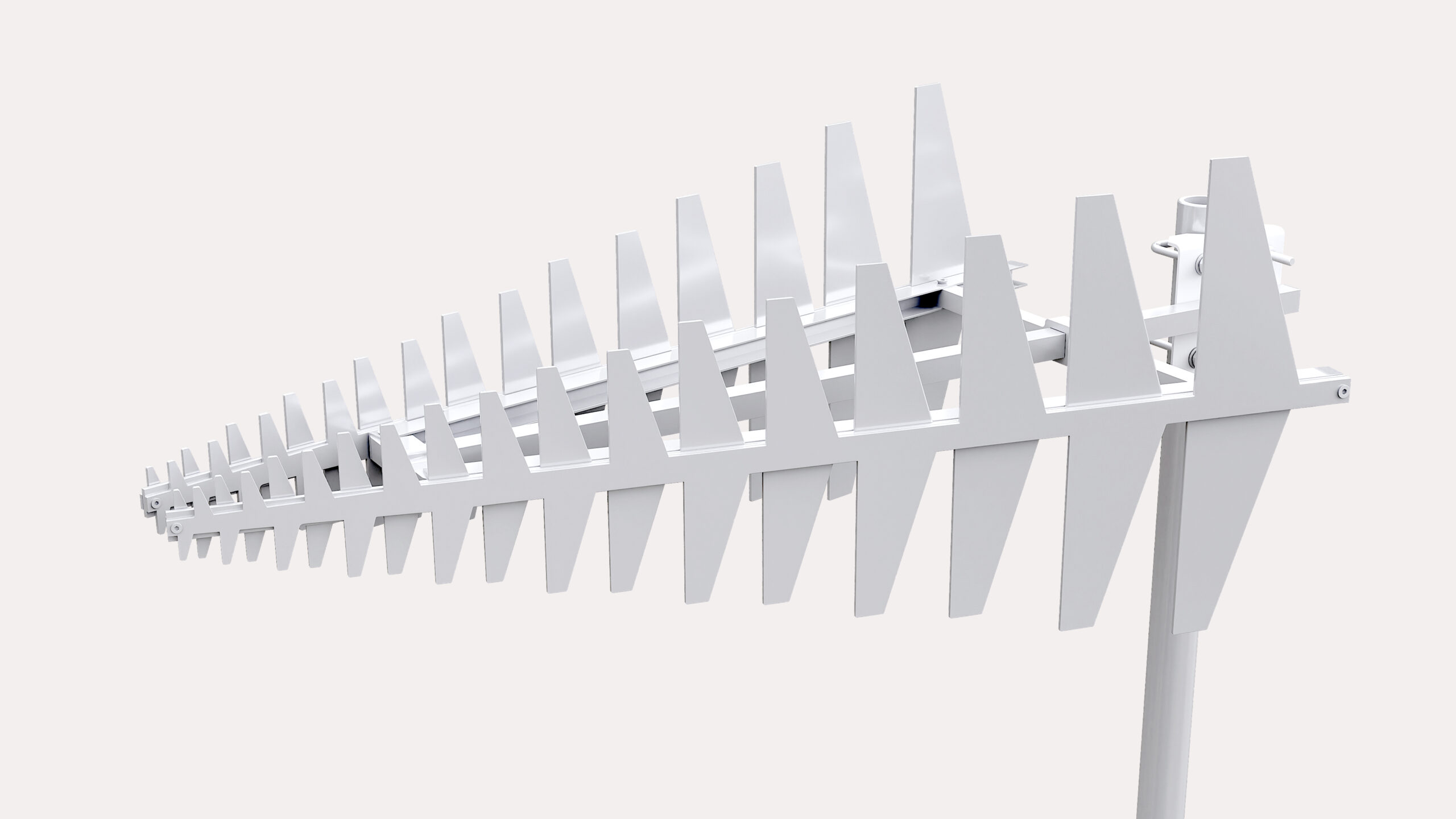
FWA is a wireless technology capable of low latency and high speeds comparable to fiber optic connections. While most landline internet service provider (ISP) plans cap maximum line speed, many mobile network operators offer SIM cards with uncapped speeds that are significantly cheaper than landline ISP offerings.
DIY Solution
With a mobile SIM fixed wireless solution user can influence maximum internet speeds via hardware selection. In fixed wireless access (FWA) systems, signal-to-interference-plus-noise ratio (SINR) is the key determinant of achievable data speed, because it directly controls which modulation and coding scheme (MCS) the base station and customer-premises equipment (CPE) can sustain. In simple terms, a higher SINR means the signal is cleaner and less corrupted by interference, allowing the network to use denser modulation formats such as 64-QAM, 256-QAM, or 1024-QAM. Each increase in modulation level allows more bits to be transmitted per symbol — for example, 64-QAM carries 6 bits per symbol, 256-QAM carries 8, and 1024-QAM carries 10 — effectively boosting throughput without requiring extra bandwidth.
However, these high-order modulation modes are only stable when SINR is strong, typically above 20–25 dB for 256-QAM and 30 dB+ for 1024-QAM. When SINR drops below those thresholds due to distance, multipath fading, or interference from nearby cells, the system must fall back to lower-order modulation schemes like 16-QAM or even QPSK, which trade off data rate for robustness. In practical FWA scenarios, this can mean the difference between 1 Gbps+ at high SINR and less than 50 Mbps at low SINR.
Antenna selection
As a result, improving SINR through better antenna selection is often the most effective way to increase real-world download speeds in fixed wireless links.
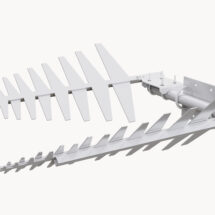
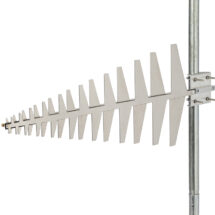
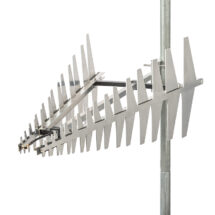
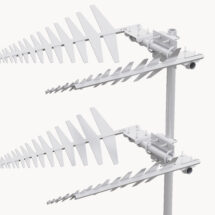
A high-gain Log-Periodic Dipole Array (LPDA) antenna is one of the most effective tools to achieve this improvement. Unlike compact omni or panel antennas, an LPDA focuses the received and transmitted energy in a specific direction, increasing signal strength while rejecting off-axis interference. This directional gain directly enhances SINR — not just by amplifying the desired signal, but by reducing the amount of noise and cross-cell interference the modem must contend with. The result is a cleaner link that supports higher modulation levels and maintains those speeds even under challenging network conditions.
For users in fringe or suburban areas, upgrading to a high-gain LPDA can transform an unstable 4G or 5G connection into a fiber-like experience, with lower latency, faster downloads, and fewer dropouts. It’s a simple, affordable, and future-proof way to unlock the full potential of fixed wireless access — especially as carriers expand high-capacity 5G networks across regional areas. In short, better SINR equals better speed, and nothing improves SINR like a well-aligned high-gain LPDA antenna.
Showing all 4 results